

This article contains affiliate links to relevant editions on Amazon. As an Amazon Associate, Ginger Cat Publishing earns from qualifying purchases.
The Story of Mary Jones and Her Bible still matters because it reminds us what it means to truly value something. Mary Jones did not regard the Bible as an ordinary book that happened to be missing from her home. She longed to read it for herself, worked patiently towards owning a copy and was willing to make a difficult journey to obtain it.
First published in 1882, Mary Emily Ropes’s retelling introduces modern readers to a world in which books were expensive, education could not be taken for granted and a Welsh Bible might be shared by an entire community. Yet this is more than a historical story about the scarcity of books. It is a deeply Christian account of perseverance, faith and a young girl’s love for the Word of God.
More than a century after it was written, Mary’s story continues to speak to families, younger readers and anyone who has ever had to wait and work for something precious.
What is The Story of Mary Jones and Her Bible about?
Mary Jones was born in 1784 and grew up near Llanfihangel-y-Pennant, beneath the mountain of Cadair Idris in North Wales. Her family was poor, and there was no Bible in their home.
From an early age, Mary loved hearing the stories of Scripture. Before she could read, she listened carefully and remembered as much as she could. Once she had learnt to read, however, her desire for a Bible of her own grew even stronger.
A neighbouring farmhouse possessed a Bible, but reaching it required Mary to walk approximately two miles. She made the journey regularly so that she could read and study from its pages. The inconvenience did not discourage her. Instead, it strengthened her determination to obtain a Bible for herself.
Mary began saving whatever small amounts of money she could earn. For six years she worked towards her goal, gathering coins through patience, thrift and ordinary acts of labour.
By 1800, she had saved enough to purchase a Bible. She then walked from her home to Bala, a journey of approximately 25 or 26 miles, to see the Reverend Thomas Charles, who supplied Welsh-language Bibles.
The meeting between Mary and Thomas Charles became closely associated with the movement that led to the formation of the British and Foreign Bible Society in 1804. One young girl’s desire for a Bible helped reveal how many other people were waiting for the opportunity to possess and read the Scriptures in their own language.
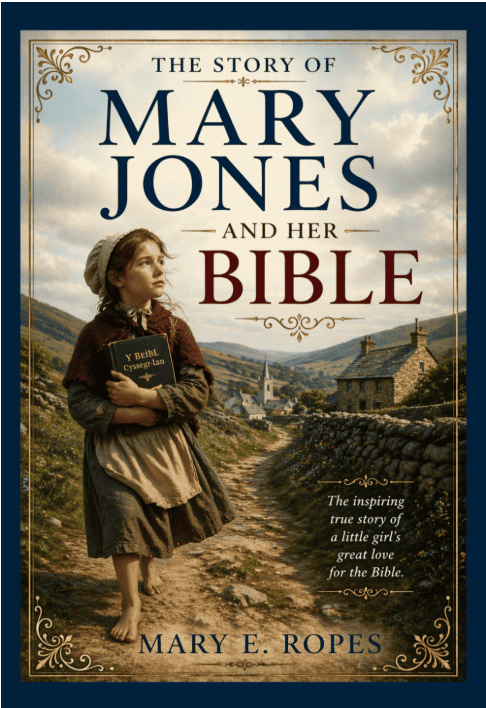
A story about loving the Bible
It is easy for modern readers to concentrate on Mary’s long walk to Bala. It is the most dramatic and memorable part of the story, but the walk only occurred because of everything that came before it.
Mary’s journey began long before she set out for Bala.
It began when she listened intently to the Bible stories remembered by her parents. It continued when she attended religious meetings and tried to retain the passages she heard. It grew stronger when she learnt to read and discovered that the ability to read was of limited use if she had no book available to her.
Mary did not want a Bible as an ornament or as something to be displayed proudly in her home. She wanted to read it, learn from it and allow it to shape her life.
That distinction is important. The heart of the story is not simply that Mary wanted to own a particular object. She wanted access to the words contained within it.
For readers who have several Bibles at home, as well as immediate access to Scripture on phones, tablets and computers, Mary’s longing may feel almost unfamiliar. Her story gently challenges us to consider whether easy access has made us more grateful for the Bible or merely more accustomed to its presence.
Faith expressed through ordinary work
Mary Emily Ropes presents Mary as a child of unusually sincere faith, but she does not portray her as someone who sits passively and waits for her prayers to be answered.
Mary works.
She helps at home, undertakes small tasks and saves what she earns. Her goal is reached through many apparently insignificant decisions made over a period of years.
This is one reason the story remains valuable for younger readers. Mary’s perseverance is not expressed through a single heroic moment. Her eventual journey to Bala is remarkable, but it rests upon years of quiet preparation.
The book shows that faithfulness is often found in ordinary responsibilities. Mary cannot immediately change her circumstances, but she can make good use of the opportunities available to her. She can learn, work, save and continue hoping.
Her example offers a contrast to the expectation of immediate results that can shape modern life. Mary’s progress is slow. There are no shortcuts, and no sudden solution appears to remove the difficulty. She must keep going without knowing exactly when her desire will be fulfilled.
For children and adults alike, that remains a meaningful lesson.
Why Mary’s poverty matters to the story
Mary’s family did not lack a Bible because they were indifferent to Christianity. They lacked one because books were costly and Welsh Bibles were scarce.
That historical setting gives the story much of its emotional force. Mary’s parents can teach her what they remember, and she can listen to Scripture at religious meetings, but personal access to the text remains beyond the family’s means.
The book allows modern readers to enter, however briefly, a world in which literacy and access to books were precious privileges. Learning to read opened a door for Mary, but she still needed something to read.
Her poverty is never presented as evidence that her life is without richness or meaning. Her home contains affection, faith, instruction and a strong sense of responsibility. Nevertheless, the family’s material limitations are real. Every coin Mary saves represents effort, and the Bible she eventually seeks is a considerable purchase.
Understanding this helps us recognise why obtaining the book mattered so much. Mary was not making a casual shopping trip. She was devoting years of her childhood to acquiring something that her family could not otherwise afford.
A Christian story that takes faith seriously
Some older Christian books add a religious lesson to a story that could otherwise exist without it. That is not the case here.
Christian faith is the reason for Mary’s longing, the source of her perseverance and the foundation of the book’s meaning. Remove her love of Scripture and there is no story.
This is one of the qualities that makes The Story of Mary Jones and Her Bible particularly suitable for families seeking Christian literature. Prayer, trust in God, self-discipline and love for the Bible are not treated as unusual additions to life. They are woven naturally into Mary’s home, her education, her relationships and her ambitions.
The book was written during the Victorian period, when stories for younger readers frequently combined entertainment with moral and religious instruction. Modern readers may find some passages more openly instructive than those in contemporary children’s books. However, Ropes also creates a recognisable child at the centre of the narrative.
Mary is eager, curious and sometimes impatient. Her great desire gives her purpose, but she must learn how to express that desire through faithfulness in her present responsibilities. She is presented as an example, but she is not merely an abstract list of virtues.
The power of one apparently small life
Mary Jones was not wealthy, influential or highly educated. She was a girl from a poor Welsh family who wanted a Bible.
From the perspective of the wider world, her private longing might have appeared insignificant. Yet the story of her journey came to represent the need for more widely available Scriptures, particularly in languages spoken by ordinary people.
The British and Foreign Bible Society was established in 1804, four years after Mary’s journey to Bala. Its formation involved many people and cannot be attributed to Mary alone. Nevertheless, her experience became an important part of the Society’s history and helped give a human face to the shortage of affordable Welsh Bibles.
That careful distinction does not diminish Mary’s importance. Instead, it helps us understand it properly.
Mary did not set out to establish an international organisation. She set out to obtain a Bible. The wider consequences grew from a faithful personal act undertaken without any expectation of recognition.
There is something deeply encouraging in that. People do not always know what may grow from the decisions they make quietly and sincerely. Mary’s story reminds us that a life need not appear powerful to have influence.
Is the story historically true?
Mary Jones was a real person, and the central events of her story are rooted in history. She was born in 1784, travelled to Bala in 1800 and obtained a Welsh Bible from Thomas Charles. Bibles associated with Mary have survived, together with archival material and later recollections concerning her life and journey.
However, as with many cherished historical stories, some details vary between accounts. Later devotional retellings sometimes arranged conversations and events into a more complete narrative than the surviving evidence can independently verify.
Mary Emily Ropes was open about the nature of her work. The original prefatory material explained that the narrative had been founded upon written and verbal sources available to her. Her book is therefore best understood as a historical devotional retelling. It preserves the central truth of Mary’s experience while presenting it in the form of an engaging Christian story for younger readers.
Readers do not need to choose between appreciating the story and thinking carefully about its history. We can do both.
Is The Story of Mary Jones and Her Bible suitable for children today?
The book is particularly well suited to reading aloud, family reading and Christian home education. Its central story is easy to follow, while its historical and spiritual themes allow for deeper conversation.
Younger readers may be interested in the practical differences between Mary’s life and their own. How did children learn when schooling was limited? Why were books so expensive? What did it mean to walk more than 25 miles? Why was having a Bible in Welsh so important?
The story can also prompt more personal questions. What would we be willing to work towards for six years? Do we value things differently when they have required sacrifice? What does Mary’s example teach us about patience? How might we respond when something good remains beyond our immediate reach?
Some of the language and moral commentary reflect the period in which the book was written. For many readers, this is part of its value. It provides an opportunity to encounter an older Christian voice while considering which parts of Mary’s example remain relevant today.
Why Mary Jones still matters
Mary Jones still matters because her story asks a simple but searching question: what do we truly treasure?
Her love for the Bible was revealed through what she was prepared to do. She learnt to read, walked to borrow a copy, worked for years, saved her small earnings and finally travelled across the Welsh countryside to obtain one of her own.
The world has changed considerably since Mary made her journey in 1800. Bibles are no longer scarce in the same way for most British readers, and the journey to Bala can now be completed without days of walking. Yet patience, gratitude, faithfulness and love for Scripture have not ceased to matter.
Mary’s circumstances may belong to another century, but the questions raised by her life remain close to us.
What is worth waiting for? What is worth working for? What place does Scripture truly hold in our lives? And what might God accomplish through a person whose faithfulness appears small to everyone else?
That is why The Story of Mary Jones and Her Bible remains more than a historical curiosity. It is a quiet Christian classic about a girl with very little money, a long road before her and a desire strong enough to carry her all the way to Bala.
The Ginger Cat Publishing edition of The Story of Mary Jones and Her Bible preserves Mary Emily Ropes’s original account while providing helpful context for modern readers. If you would like to discover Mary’s remarkable journey for yourself or share it with your family, the book is available from Amazon.