
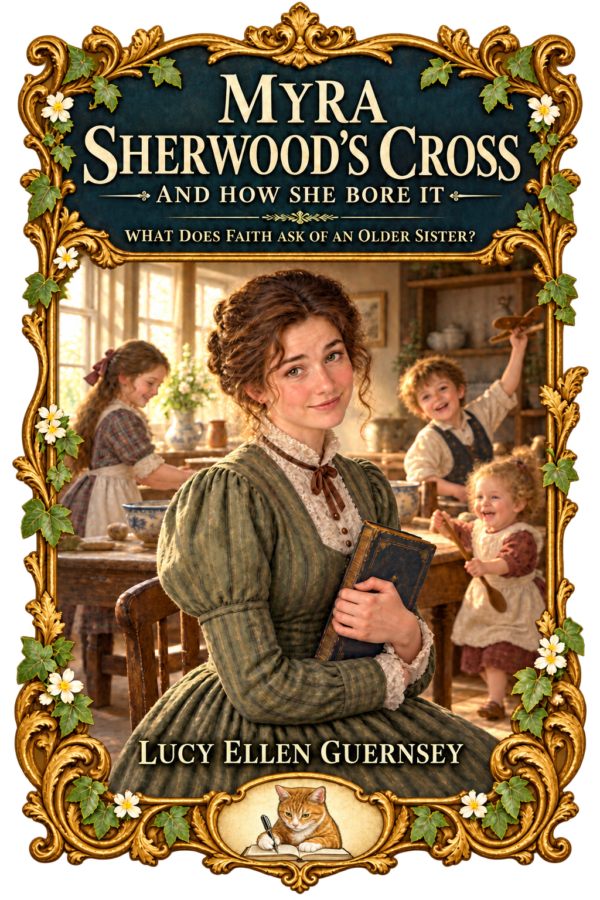
When a family loses its home, Myra Sherwood crosses from the life she knows to offer its children a place with her.
Raised in the loving household of her aunt and uncle at Mentone, Myra has grown into a young woman of settled Christian faith and independent means. Her ties to her father’s other children have been distant, though she has long wished they might be closer. Then a sudden tragedy leaves them and three younger children without the parents who held their household together. Myra travels to England before she knows whether her help will be wanted.
She finds grief, uncertainty and a family whose feelings towards her are far from simple. Harry and Florence remember their older sister, but the younger children must learn who she is. Their former home cannot be kept as it was. Myra resolves to build another, one in which each child can be cared for without feeling merely dependent on her.
That resolve is easier to make than to live by. Some of the children welcome her warmth; others test her patience or mistrust her intentions. Their different ages and temperaments call for more than a single generous gesture. Myra must work out when to guide, when to listen, and how to remain faithful to a choice whose cost she could not measure in advance. She also has hopes for her own future, and those hopes do not disappear because others need her.
Lucy Ellen Guernsey’s Myra Sherwood’s Cross, and How She Bore It follows a household across years of change. It is a nineteenth-century Christian family story about sisterly love, responsibility, pride and the difficult work of earning trust. Its faith is woven into ordinary decisions as well as open conversations about prayer, forgiveness and what it means to follow Christ.
The story does not treat a family as peaceful simply because its members live under one roof. Affection can be awkwardly received. A young person may want independence before knowing how to use it. Help given freely may still be hard to accept. Through these tensions, Guernsey asks how a home can make room for people to grow, and how love continues when gratitude is uncertain.
At the centre is a young woman who wants to do right without asking the children to become copies of her. Myra’s steadiness is tested by the small frictions of shared rooms and by the larger question of what she may have to set aside. The book leaves room to consider whether giving and receiving care can each require courage. Its young characters bring energy, impatience and vulnerability to a story whose moral questions arise from their lives together.
First encountered through a nineteenth-century edition, the novel retains the language and direct religious conversation of its time. Readers will find a substantial story rather than a modern retelling: family life, work and travel unfold alongside passages that pause to consider Christian belief. The setting stretches from a Mediterranean household to England, while letters and departures remind the family that their world reaches beyond its cottage walls.
This Ginger Cat Publishing edition presents the original public-domain text without the historical illustrations. An introduction, author and historical context, a modern-reader reflection, and questions for thought accompany the story. These pages offer context and conversation while keeping Guernsey’s own voice at the centre.
For readers drawn to reflective classic Christian fiction and family stories in which faith is part of everyday life, Myra’s journey offers much to linger over.