

This article contains affiliate links. As an Amazon Associate, Ginger Cat Publishing earns from qualifying purchases.
Some historical novels carry us safely into the past. They introduce distant places, unfamiliar customs and dramatic events, but allow us to remain spectators. Deborah Alcock’s By Far Euphrates does something more demanding. It takes a crisis that can easily become a collection of dates and numbers and brings us close enough to see the people within it.
First published in 1897, the novel follows fifteen-year-old John “Jack” Grayson, an English traveller who journeys through the Ottoman Empire with his widowed father. Jack expects adventure, ancient landscapes and perhaps the discovery of early Christian manuscripts. He does not expect illness and loss to leave him dependent upon the kindness of an Armenian Christian family.
Within their home, the distant country becomes personal. Jack discovers friendship, hospitality, faith and belonging. He also becomes aware of the unequal and precarious conditions under which the Armenians live. His English nationality gives him a degree of protection that cannot be extended automatically to those he has come to love.
Around this deeply human story, danger gathers.
By Far Euphrates is a grave yet tender novel about faith under persecution, the moral responsibility that accompanies privilege and the painful question of whether God can still be trusted when deliverance does not come. It is not always an easy book, but it is one that deserves to be read slowly, thoughtfully and with an awareness of the real history from which it grew.
A Dark River Transformed by Light
The governing image of the novel appears near its beginning.
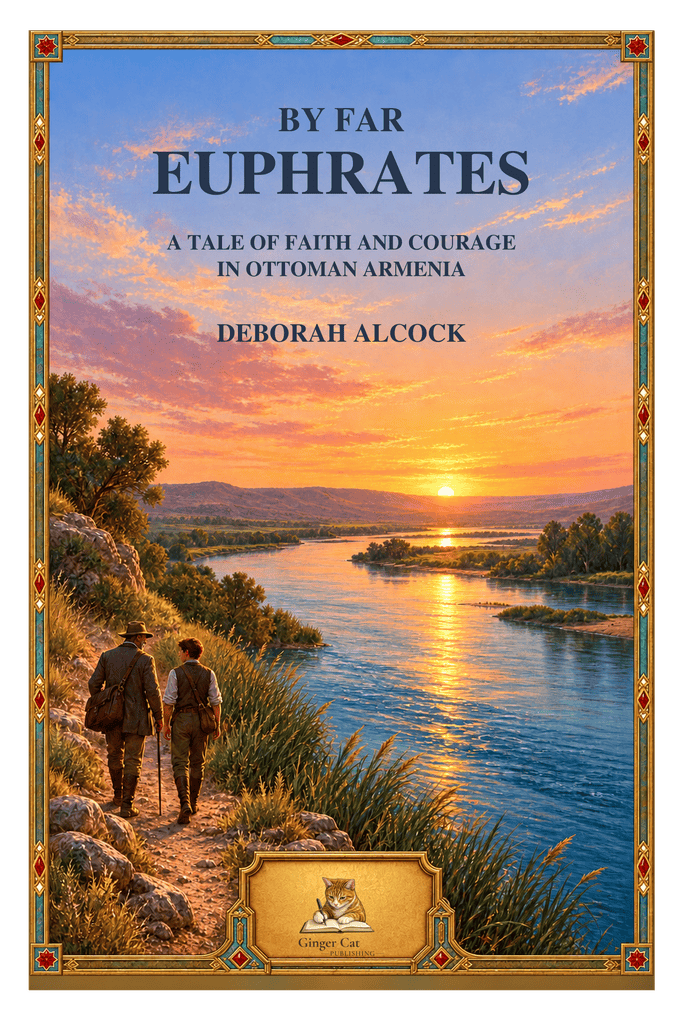
When Jack first sees the Euphrates, he is disappointed. The legendary river of Scripture and ancient history looks dark and muddy. It does not immediately possess the grandeur he had imagined. As the sun sets, however, the water is transformed. Light falls across its surface and the dark river turns to gold.
That change becomes far more than a beautiful landscape. It expresses the central spiritual question of By Far Euphrates.
Can light remain real when darkness is also real?
Alcock does not suggest that suffering becomes beautiful simply because someone responds to it courageously. The river does not cease to be dark water. The light does not erase what lies beneath it. Instead, the sunset reveals that darkness is not the whole truth.
This distinction matters because the novel deals with persecution, bereavement, imprisonment, massacre and the particular vulnerability of women and children. Although Alcock usually describes the worst events with restraint, their emotional effect is considerable. Readers should not approach the book expecting a gentle historical romance or an uncomplicated tale of adventure.
Yet neither should they expect a story without warmth. Alcock gives real importance to hospitality, family meals, flowers, embroidery, friendship, Scripture, laughter and the ordinary work of caring for others. These details are not merely moments of relief placed between darker scenes. They show us what persecution threatens.
The people in the novel do not matter only because they suffer. Their suffering matters because their lives matter.
From English Traveller to Armenian Household
Jack begins the story as an intelligent but inexperienced young traveller. The Ottoman Empire is unfamiliar territory to him, filled with places associated with the Bible and the earliest centuries of Christianity. His father’s interest in ancient manuscripts gives their journey an almost romantic purpose.
That romance does not survive unchanged.
When catastrophe leaves Jack ill and separated from everything familiar, he is received into the household of Hohannes Meneshian. The Meneshians do not treat him merely as an inconvenient foreigner who must be kept alive until someone else takes responsibility for him. They welcome him with a generosity that gradually turns dependence into belonging.
Through this family, Alcock builds the emotional heart of By Far Euphrates. Political conditions are experienced through the decisions of parents, siblings and young people. Fear enters questions about travel, money, marriage and safety. The arbitrary interest of a powerful official can threaten an entire household. Promised legal equality means little when local authorities are unwilling to protect Christian subjects.
Jack’s growing attachment to Shushan, the intelligent and courageous daughter of the family, deepens his connection to this world. Their relationship gives the novel a tender romantic thread, but Alcock never allows it to become detached from the realities around them. Love raises practical and moral questions. What does protection mean when one person’s nationality carries influence and another person’s does not? Is affection enough when remaining beside someone may involve real danger?
Jack must gradually recognise that his position is different from that of the Armenian people who have embraced him. His English identity may attract diplomatic concern. Their lives may be treated as though they can be taken without consequence.
This inequality becomes one of the novel’s most searching concerns.
The Privilege of Being Protected
Privilege is sometimes discussed as though recognising it requires a person to feel ashamed of every advantage. Alcock’s treatment is more useful and more demanding. Jack is not asked to apologise for being English or to pretend that his relative protection does not exist. He is asked to decide what he will do with it.
Safety can become a wall behind which someone hides, or it can become a resource used in the service of others.
This question remains painfully recognisable. Nationality, passports, wealth, public visibility and political influence still affect who can cross a border, receive assistance or attract international attention. Two people may face the same danger while possessing entirely different chances of escape.
By Far Euphrates asks whether protection creates responsibility. If we are safe while another person is not, does gratitude complete our duty? If our voice is more likely to be heard, are we willing to use it? When suffering happens beyond our immediate reach, what does love require of us?
Alcock does not pretend that one individual can solve a political crisis. Neither does she allow limited power to become an excuse for indifference. Her characters can shelter someone, nurse a wounded person, tell the truth, preserve testimony, share money, resist cruelty or refuse to abandon a neighbour.
Large acts of evil do not make small acts of mercy meaningless. They make them necessary.
The History Behind the Novel
When Deborah Alcock published By Far Euphrates in 1897, she was writing close to the events that had stirred her. To modern readers, the book is historical fiction. To its first readers, it was almost contemporary fiction.
The novel arose from reports of the Hamidian massacres of 1894 to 1896, named after the Ottoman sultan Abdul Hamid II. These events occurred approximately two decades before the Armenian genocide of 1915 and 1916. The two periods belong to a longer history of Armenian persecution and insecurity, but they should not be confused.
Armenians had lived across Anatolia and neighbouring regions for centuries. Most belonged to the Armenian Apostolic Church, one of the world’s oldest Christian traditions. Alcock generally uses the nineteenth-century Western term “Gregorian Church”, referring to the Armenian Church associated with Saint Gregory the Illuminator.
Armenian communities possessed their own churches, schools, charitable institutions, family networks, crafts and literary traditions. They participated in trade and worked as merchants, artisans, tailors and professionals. Their lives cannot be understood only through the persecution they suffered.
Within the Ottoman system, recognised Christian and Jewish communities possessed a degree of authority over their internal religious and communal affairs. This limited autonomy did not amount to full equality. Non-Muslim subjects remained socially and legally vulnerable, and their security could depend upon the character of local officials and the willingness of authorities to enforce the law.
Nineteenth-century reform programmes promised greater equality and protection. The 1856 Reform Edict declared that Christians and Muslims should receive equal treatment before the law, but practice varied enormously. Corruption, unequal access to justice and local resistance could make official protections largely theoretical.
This is why apprehension pervades the Armenian households in By Far Euphrates. Fear is not an occasional interruption. It has become part of ordinary calculation. Families must consider whom they can trust, when a journey is safe, how to approach an official and what recourse they possess when a powerful person chooses to act against them.
The Hamidian Massacres
The immediate sequence of violence began in the Sasun district in 1894. Conflict surrounding taxation and resistance was met with a severe military response and widespread killing. International pressure for investigation and reform followed, but the proposed changes did not bring security.
During 1895, massacres spread through towns and districts across Anatolia. Armenian homes and businesses were looted. Men were killed, women and children were attacked, and churches, schools and monasteries were damaged or destroyed. Forced conversion occurred in some places. The violence continued into 1896 and affected other Christian communities as well as Armenians.
The number of people killed remains disputed. Estimates have ranged from tens of thousands to several hundred thousand. Whatever figure is used, numbers alone cannot convey what followed. Survivors faced homelessness, hunger, disease, imprisonment and the loss of family members and livelihoods. Thousands of children were left without one or both parents.
Alcock sets important parts of her story in Biridjik, now Birecik, and Urfa, now Şanlıurfa.
Birecik stands beside the Euphrates in present-day Türkiye. It occupied an important route between Aleppo and Urfa, with travellers and merchants crossing the river by ferry. Urfa was historically associated with ancient Edessa and possessed religious importance for Christians and Muslims alike.
The massacre at Urfa occurred in two principal outbreaks during the autumn and winter of 1895. The most destructive came at the end of December. Armenian homes and businesses were plundered, many people were killed, and the Armenian cathedral became the site of a particularly terrible episode after thousands sought refuge in and around it.
British Vice-Consul Charles Fitzmaurice investigated events in Urfa, Birecik and the surrounding region. Alcock explains in her appendix that she drew extensively upon his official report, together with testimony supplied by people who had been present.
This does not make By Far Euphrates an official historical report. Alcock altered names, created fictional relationships and shaped documented incidents into a narrative. Her appendix is important because she acknowledges these methods openly. She wanted readers to understand that although the novel was fiction, the examples of courage, persecution and Christian witness within it were rooted in contemporary testimony.
Faith When Rescue Does Not Come
Many Christian stories confirm faith through visible deliverance. Prayer is answered in the hoped-for way, danger is overcome, and apparent disaster becomes the path towards a happy conclusion.
Alcock could not consistently follow that pattern. She was writing in response to suffering that had not ended in earthly rescue.
This changes the meaning of faith within By Far Euphrates. Trust cannot mean confidence that nothing terrible will happen. The characters already know that terrible things have happened, and they understand that they may happen again.
Some characters find strength in the conviction that Christ remains present even when He does not remove them from danger. Others struggle to understand how His presence can be enough. The novel does not resolve that tension with a neat explanation.
To say that God is with someone in suffering is not the same as explaining why the suffering was permitted.
Alcock allows protest, bewilderment and spiritual exhaustion to be heard. Her characters ask why God appears silent and how belief can survive after witnessing deliberate cruelty. These questions are not dismissed as the foolishness of people who simply need to have more faith. They arise from grief and moral outrage.
A reader may find that the book strengthens faith. Another may find that it disturbs familiar answers. Those responses do not necessarily contradict one another. Faith that has never been allowed to ask difficult questions may be more fragile than faith that has passed through bewilderment and continued speaking to God.
Christian Martyrdom Without Romanticising Pain
Christian martyrdom stands close to the centre of Alcock’s purpose. She honours people who were offered life in exchange for denying Christ and refused to do so.
Their courage should not cause us to treat the suffering itself as desirable. Cruelty does not become good because a victim responds to it faithfully. The honour belongs to the person who refuses to surrender conscience, never to the violence that created the test.
Alcock is at her strongest when her courageous characters remain fully human. They experience fear, grief and a longing to live. Courage does not require terror to disappear. It may mean choosing faithfulness while terror remains.
Modern readers may also wish to extend compassion towards those who yielded under extreme threat. A tortured prisoner, a terrified child or a parent desperate to protect a family is not making a free religious choice in any ordinary sense. Alcock concentrates upon those she understood as martyrs, but honouring their steadfastness does not require us to condemn victims whose fear overwhelmed them.
Coercion places guilt upon the coercer.
Forgiveness Without Forgetting
Another of the novel’s difficult questions concerns forgiveness.
Alcock does not present Christian forgiveness as an agreement to pretend that nothing serious has happened. Evil must be named truthfully. Victims must be remembered, testimony preserved and further wrongdoing resisted.
Forgiveness becomes meaningful precisely because the wrong is real. It asks whether hatred and private vengeance can be relinquished without relinquishing truth or justice.
That distinction is important. Reconciliation may require repentance, accountability, safety and changed conduct. Forgiveness does not demand silence from witnesses, nor does it require continued access to someone who remains dangerous.
Alcock also resists the temptation to make every member of a community morally identical. By Far Euphrates includes Muslim characters who choose friendship, compassion and considerable personal courage. Their actions do not erase the larger violence, but neither should the larger violence erase their moral individuality.
This gives the novel more complexity than a simple division between a wholly innocent people and a uniformly cruel one. Systems, authorities and collective violence matter, but individuals still make choices within them. Some follow the crowd. Some exploit its cruelty. Others warn their neighbours, conceal fugitives or risk their own safety to save a life.
The question eventually turns towards the reader: what do I choose when conscience requires courage?
Women, Vulnerability and Quiet Strength
The women in By Far Euphrates face dangers that Alcock approaches with deliberate restraint. She makes the threat of sexual violence and forced captivity clear without describing either graphically.
Her reticence reflects Victorian conventions, personal sensitivity and an unwillingness to make suffering into spectacle. Modern readers may appreciate that restraint while recognising the realities concealed behind phrases such as “worse than death”.
That older expression must be treated carefully. A woman who survives sexual violence has not lost a purity that death would have preserved. The shame belongs entirely to the perpetrator.
Nor are Alcock’s women important only because they are endangered. They educate, organise, nurse, protect children, preserve faith and make difficult decisions. Domestic work becomes a form of strength. Embroidery represents skill, creativity and sometimes the possibility of income. Hospitality preserves dignity even under pressure.
Some acts of courage are dramatic. Others consist of continuing the next necessary task when life has become almost unbearable.
Deborah Alcock and the Lives Within History
Deborah Alcock was born in Waterford, Ireland, in June 1835. The daughter of Church of Ireland clergyman John Alcock and his wife, Jane Innes, she grew up in a household where Christian faith shaped the understanding of life, history and duty.
Her father reportedly discouraged much contemporary fiction, but Sir Walter Scott was permitted. The exception was significant. Scott demonstrated how fictional characters could be placed within great historical movements without disappearing beneath them.
Alcock began publishing during the 1850s and gradually established herself as a writer of religious history and historical fiction. Her best-known work became The Spanish Brothers, a novel set amid the Reformation and the Spanish Inquisition. It was translated into several languages, and for years Alcock was identified on title pages simply as “the Author of The Spanish Brothers”.
Her novels travelled widely through history. She wrote about Reformation Scotland, Napoleonic Russia, Renaissance Italy, old France, Bohemia and the Thirty Years’ War. Again and again, she returned to people whose beliefs placed them in conflict with official power.
Alcock was not a detached academic historian. Her Protestant convictions were openly expressed, and her sympathies shaped the stories she told. She conducted substantial research, but facts alone were never enough for her. Readers had to care about the people living through them.
That is why food, clothing, courtship, family disagreements, financial worries, friendship and work matter so much in her fiction. History reaches us through the ordinary details of a life.
When the Armenian crisis came to her attention, Alcock had spent decades imagining religious persecution in the past. Now she encountered similar questions in her own time. She did not travel to Urfa or witness the massacres personally. Her knowledge came through missionary correspondence, published testimony, diplomatic reports and eyewitness accounts.
She was candid about both her sources and her purpose. She wanted to honour Armenian Christian courage, strengthen faith and awaken practical concern for survivors, widows and orphans.
By Far Euphrates therefore stands close to the boundary between novel, testimony, Christian reflection and humanitarian appeal.
Reading Alcock Honestly Today
A modern edition should neither hide Alcock’s limitations nor allow them to obscure everything valuable in her work.
She wrote as a nineteenth-century British Protestant interpreting Armenian and Ottoman life through translated testimony and missionary or diplomatic sources. Some of her generalisations reflect the assumptions of her period. Her narratorial voice can be direct, openly emotional and explicitly religious in ways that differ from much modern fiction.
Recognising this does not require us to reject the novel entirely. Nor does valuing the novel require us to accept every description without question.
Alcock’s treatment of Armenian Christianity is particularly notable. Western Protestant writers sometimes treated ancient Eastern churches as spiritually lifeless until revived by missionary influence. Alcock makes a deliberate attempt to honour the faith of Armenian Apostolic Christians as well as Armenian Protestants.
She even explains that she omitted the Protestant congregation historically present in Biridjik because she wanted to portray the Christian life of an Apostolic family without implying that genuine faith existed only where foreign missionaries had introduced it.
That choice is historically artificial, and Alcock acknowledges it. Yet the purpose behind it is unusually generous for her context.
The same care should govern our reading of her Ottoman Muslim characters. The persecution and massacres were real and must not be softened into a vague misunderstanding between equal parties. At the same time, no ethnic or religious population is morally uniform. The Muslim characters who resist cruelty matter because they restore individual responsibility and choice.
Why Bring This Book Back?
Public-domain books are readily available in digital archives, but availability is not the same as accessibility.
An older novel may survive online while the paths leading modern readers towards it become overgrown. Unfamiliar place names, historical circumstances, religious language and cultural assumptions can make a worthwhile book feel more distant than it needs to be.
The Ginger Cat Publishing edition of By Far Euphrates preserves Alcock’s original novel while surrounding it with material designed to support thoughtful reading. It includes an introduction to the story and its historical setting, an exploration of the Armenian and Ottoman world behind the novel, an account of Deborah Alcock’s life and work, guidance for reading the book today, and reflective Points to Ponder.
The aim is not to turn the novel into a textbook or tell readers what conclusions they must reach. It is to help them recognise where history and fiction meet, understand Alcock’s perspective and enter the story with enough context to appreciate what is at stake.
This is a book for readers who value substantial Christian fiction, Victorian historical novels and stories willing to ask questions that do not have easy answers. It may also appeal to older teenage readers, since Jack is fifteen and his moral growth is central, although the mature subject matter makes guidance advisable for younger readers.
Most of all, it is for readers willing to pay attention.
What Happens After Compassion Is Awakened?
Alcock understood that suffering viewed from a distance can become abstract. A large number may shock us without helping us comprehend the individual lives it represents.
A novel cannot restore those lives. It cannot undo injustice or guarantee that history will not repeat itself. It can, however, change the quality of our attention.
It can teach us to pause over a name. It can make us question why one life receives protection while another does not. It can remind us that a persecuted community possesses family life, faith, humour, work, beauty and hope beyond the terrible events by which history may remember it.
By Far Euphrates does not ask readers merely to admire courage or feel sorrow. It asks what follows sorrow.
Can the protected person become a protector? Can the survivor become a witness without believing survival itself was a betrayal? Can forgiveness coexist with truth and justice? Can faith continue speaking when familiar answers have failed? Can a distant life become real enough to alter our choices?
The book’s dark river does not disappear. Alcock offers no shallow comfort and no promise that every earthly loss will be restored. Her hope is quieter and more costly.
It appears when someone shelters a neighbour, cares for a wounded person, preserves a testimony, protects a child or redirects a life towards service. It appears whenever cruelty is denied the right to speak the final word.
The dark water remains, but it receives the light.
That is the enduring challenge and beauty of By Far Euphrates, and it is why this forgotten novel is worth bringing back into print, worth reading with care and, above all, worth lingering over.
Sources Consulted
Deborah Alcock, By Far Euphrates: A Tale, including the author’s original preface and appendix. Project Gutenberg: https://www.gutenberg.org/ebooks/49915
UK Parliament, House of Lords debate on Armenia, 8 May 1896: https://hansard.parliament.uk/Lords/1896-05-08/debates/55432063-f9a6-4207-975a-a0eaa606b39b/Armenia
Armenian National Institute, “Hamidian Massacres, 1894–1896”: https://www.armenian-genocide.org/hamidian.html
Selim Deringil, “The Armenian Question Is Finally Closed: Mass Conversions of Armenians in Anatolia during the Hamidian Massacres of 1895–1897”, Cambridge University Press: https://www.cambridge.org/core/journals/comparative-studies-in-society-and-history/article/armenian-question-is-finally-closed-mass-conversions-of-armenians-in-anatolia-during-the-hamidian-massacres-of-18951897/D7D6E4351CBF8D04FCC9E87AABFC565E
Seda A. Parsamyan, “Mass Destruction of Armenian Cultural Heritage during the Hamidian Massacres”, Armenian Genocide Museum-Institute: https://agmipublications.am/index.php/ijags/article/download/80/80/83
Cambridge and North London Armenian Community Association, history of British Armenian organisations: https://caia.org.uk/projects/armenians-ww1/armenian-community-and-ww1/
Dictionary of Irish Biography, “Deborah Alcock”: https://www.dib.ie/biography/alcock-deborah-a0085
At the Circulating Library, “Deborah Alcock”: https://www.victorianresearch.org/atcl/show_author.php?aid=2852
Project Gutenberg, books by Deborah Alcock: https://www.gutenberg.org/ebooks/author/40565