
A dead man keeping a diary is certainly an unusual way to begin a story. Before we have met its narrator, Coulson Kernahan has already given us something to puzzle over. Who is writing, how can he be writing, and what could he possibly have to tell us? Yet the question that makes this book interesting reaches rather closer to home: what happens when a person can no longer explain away the harm he has done?
First published in 1890, A Dead Man’s Diary: Written After His Decease belongs to the stranger side of Christian fiction. There are no comfortable village certainties here, and very little opportunity to admire the scenery without being asked an awkward question. Its narrator takes us into an imagined spiritual world, but the trouble waiting for him begins in an earthly life. He has found ways of living with his past, and those ways are about to fail him.
I chose it for Ginger Cat Publishing because its unusual premise leads into serious questions about conscience, responsibility and the need for Christ’s mercy. I also knew that publishing it would require honesty about its theology. Kernahan imagines opportunities for repentance after death, spiritual progression and companionship involving departed people. Those ideas are not endorsed by my imprint or presented as biblical teaching. This edition preserves his fiction and gives readers room to examine it with care.
A strange title and a very human fear
The narrator explains the apparent contradiction in the title near the beginning. During a serious illness, he was believed dead for the greater part of two days before showing signs of returning life. He now wants to describe what he says happened during that interval. His recovery is therefore part of the opening premise, rather than a surprise waiting at the end, and the reader’s attention turns towards the account he has brought back.
He knows perfectly well that other people may doubt him. Indeed, he admits that he would struggle to accept such a story if somebody else told it. That admission makes him an interesting companion, because he is both aware of our objections and determined to answer them. We can listen to the voice Kernahan has created without accepting its confidence as evidence. In this edition, the diary is presented as fiction, not as a verified account of life beyond death.
Beneath that extraordinary claim is a fear many readers will recognise. The narrator loves the familiar world and does not want to leave it alone. Human voices and the touch of a hand can accompany someone only so far, and he finds the thought of separation deeply troubling. His way of describing it is elaborate, but the feeling itself needs little translation. The strange diary begins with a man who wants light, warmth and company, and is frightened of losing them.
A man who notices beautiful things
One of the surprises of this sombre book is how much affection it contains for ordinary life. Its narrator loves flowers, birds, sunlight, poetry and friendship. He does not believe that loving God requires him to despise the world God has made. These passages give the reader a little fresh air before the story becomes darker, and they help explain why its speaker clings so strongly to being alive.
They also make him harder to dismiss. It would be easier if Kernahan gave us someone incapable of appreciating goodness, someone whose every thought announced that he was cruel. Instead, we meet a man who can be moved by lovely things and still behave badly towards another person. His finer feelings are real, but they have not prevented serious wrongdoing. That uncomfortable combination is one of the book’s strongest concerns.
There is a familiar temptation in it. We may feel that our love of a beautiful hymn, a generous thought or a moving story says something reassuring about us. Perhaps it does, but it cannot settle every question about how we live. The person waiting for our patience or honesty needs more than evidence that we admire those qualities. Kernahan keeps bringing his narrator back to the distance between the person he appreciates in imagination and the person his conduct reveals.

When the words we choose stop protecting us
The narrator’s greatest difficulty is not a lack of language. He has plenty of it, and knows how to arrange it attractively. That becomes important when he considers his own past, because a persuasive description can make an ugly action seem less ugly. Circumstances move to the foreground, intentions are carefully explained, and the person who suffered can gradually disappear behind the account of how complicated everything was.
Most of us can recognise the habit without pretending that every failure has the same seriousness. We call ourselves outspoken when we have been unkind, or distracted when we have been thoughtless. Sometimes the explanation is fair, and sometimes it is doing rather too much work on our behalf. What matters is whether it leaves room for the truth and for the other person’s experience. Kernahan’s narrator discovers what it means to lose the protection of his preferred explanation.
The supernatural setting makes that loss inescapable. A memory can no longer be pushed aside simply because it is unwelcome, and yesterday does not become harmless because the wrongdoer has moved on. The book gives a dramatic form to the discomfort of an awakened conscience. We do not need to accept its imagined geography to understand why that prospect frightens him. He can see what he has done, and seeing it is only the beginning of his difficulty.
Remembering the person who was hurt
At the centre of that past is Dorothy, the seventeen-year-old daughter of his housekeeper. Her daily work brings her into his rooms, within a world where his position and hers are far from equal. He has the education and freedom to tell his story at length. She has far fewer opportunities to control the account of what happened or to escape its consequences. Any reading that concentrates entirely on his anguish risks repeating that imbalance.
Kernahan is concerned with the unfairness of the judgement Dorothy faces, particularly from people who consider themselves respectable Christians. Their concern for their own reputation leaves little room for practical compassion. Someone needs help, yet association with her is treated as a threat to their standing. That part of the story asks an uncomfortable question about what religious respectability is worth when it makes us less willing to come near a vulnerable person.
The author’s language needs questioning as well. His descriptions can carry old assumptions about a woman being ruined, even while he wants us to feel sympathy for her. A person’s worth is not destroyed by what has happened to her, and her life is more than a lesson for someone else. Reading fairly includes noticing both the compassion Kernahan is attempting and the limits of the words he uses. We need not choose between overlooking the difficulty and ignoring everything he has seen clearly.

The world around the diary
The book appeared in a Victorian world already busy discussing death, judgement and the reach of divine mercy. Its original preface, written by G. T. Bettany, places it among other writings about the life to come. He mentions Swedenborg, Letters from Hell and Frederic William Farrar’s Mercy and Judgment. Those references show that Kernahan was entering an existing conversation, rather than inventing a subject nobody had considered before him.
They also remind us that there was no single Victorian Christian opinion on every question the book raises. Bettany points towards differing descriptions of future punishment and blessedness, and recognises how readily human imagination supplies detail. We should be cautious about explaining Kernahan’s ideas by saying that people simply believed such things in those days. Some readers found them persuasive; others had theological objections. The disagreement belongs to the history of the book too.
Its first presentation adds another layer of uncertainty. The original title page did not name Kernahan, and Bettany describes a writer who preferred to remain anonymous. Considerable portions had already appeared in the English edition of Lippincott’s Monthly Magazine before the work was gathered into book form. Readers encountered a strange title and an account whose status the preface left open to question. An unfamiliar name was not there to tell them what to expect.
Bettany acknowledges that people might consider the narrative invented or the visions of a trance-like state, and separates the publishers from responsibility for its opinions. That does not supply proof of the narrator’s experience. It does help explain the atmosphere of the opening, where the speaker seems almost to anticipate an argument with his audience. He wants us to understand him, but he also wants us to believe him, and those are different requests.
A diary that takes its time
Readers expecting a quick supernatural adventure may be surprised by the pace. Kernahan’s narrator pauses, remembers poems, considers his fears and wanders into thoughts about beauty. Bettany’s preface defends that freedom as appropriate to a diary, whose writer can record the thoughts stirred up by what he is telling. Whether every detour appeals will depend on the reader, but the digressions are part of the book’s character rather than an accidental interruption.
The literary references are especially noticeable. Shakespeare, Wordsworth, Rossetti and Swinburne belong to the reading world the narrator carries with him. A remembered line becomes a way of recognising or expressing a feeling, much as a hymn or familiar phrase might come to mind for another person. You do not need to identify every quotation before continuing. The point is often the place those words occupy in his life, rather than a test of how widely we have read.
There is something revealing about spending time with such a talkative man. His interests make him individual, but his explanations can also make us impatient, particularly when we want him to face a difficult truth. That impatience may be useful. An articulate speaker can draw attention towards his own feelings so successfully that we forget to ask whether those feelings tell the whole story. The diary gives us plenty to hear, while leaving us responsible for how carefully we listen.

Meeting Coulson Kernahan
John Coulson Kernahan was born in Ilfracombe, Devon, in 1858 and died in Hastings in 1943. His name may be unfamiliar now, but he was a writer with interests reaching beyond this one unusual narrative. A Book of Strange Sins, God and the Ant, and The Child, the Wise Man and the Devil suggest how readily he returned to imaginative premises. His other work also included crime and stories concerned with possible changes to society.
An extraordinary starting point gave him a way to approach ordinary human conduct. What do people believe about themselves, what are they prepared to excuse, and how do their convictions survive contact with their desires? Those questions can be explored in a drawing room, but Kernahan was willing to take them somewhere far less familiar. The unusual setting attracts attention, then exposes habits that remain recognisable. His imagination often serves an argument about how people live.
For a different view of him, there is his 1917 memoir, In Good Company. Its subjects include Oscar Wilde, Swinburne and Theodore Watts-Dunton, placing Kernahan among literary people whose names may be more familiar than his own. These are his recollections, with all the personality and limitations that remembering brings. They show a man interested in writers as companions and speakers, as well as in the words they put on a page.
That literary background helps us understand the diary’s fondness for poetry, but it does not make the narrator a portrait of the author. Fiction can borrow an interest without borrowing a life. In particular, we should not repeat the wrongdoing in the story as though it were established biography. Kernahan created a speaker whose choices need examining; learning the author’s name does not remove the distinction between them.
Why I have kept the difficult parts
Bringing back an older book does not mean agreeing with everything inside it. In this case, that distinction needs to be stated plainly because the Christian concern is substantial and the imagined theology is substantial too. Kernahan is searching for an answer to guilt that human effort cannot resolve. He also provides descriptions of the spiritual world which I do not accept as biblical teaching. Neither fact should be hidden to make the book easier to describe.
Removing the passages about repentance after death or quietly rewriting them would change the work itself. It would also leave readers with a misleading impression of what Kernahan wrote. I have chosen to preserve the narrative and place clear discussion beside it. That approach allows an encounter with the original, while making the position of Ginger Cat Publishing explicit. Historical explanation can help us understand a belief without requiring us to adopt it.
There is a wider reading question here too. How do we respond to a writer who has noticed something important, but offers an answer we cannot follow? We can examine the observation and challenge the answer. We can appreciate the seriousness of a Christian concern without handing authority to every imaginative detail surrounding it. Reading with discernment leaves room for careful attention and firm disagreement in the same conversation.
When remorse cannot repair the past
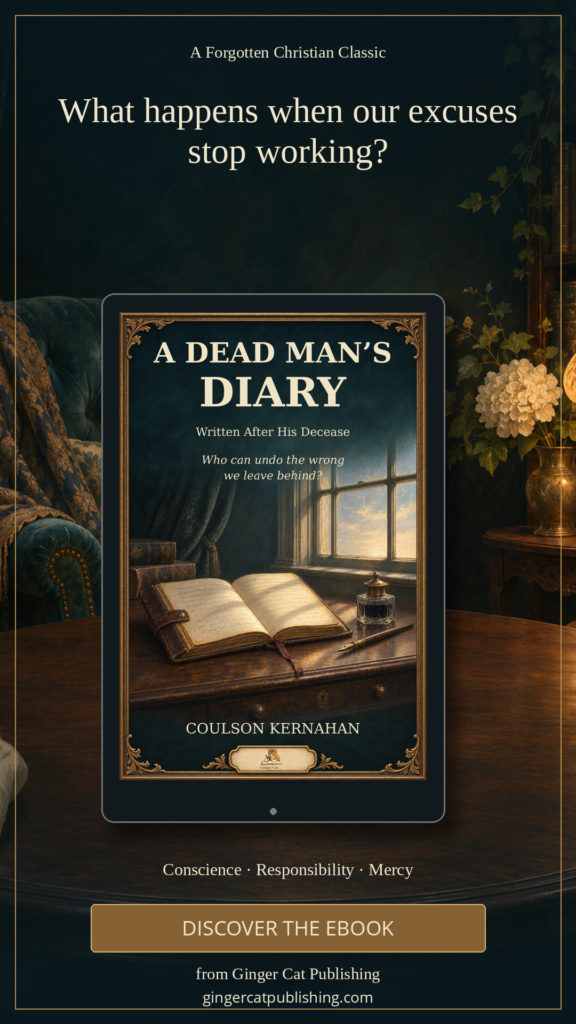
The question on this edition’s cover is, Who can undo the wrong we leave behind? It is deliberately difficult, because regret does not give us the power to return lost time or erase another person’s experience. An apology may be sincere and necessary while still being unable to restore what was damaged. The narrator’s distress grows from that limit. Knowing the truth about himself does not automatically give him the means to put everything right.
This is where the book’s dependence on Christ matters. Kernahan does not ultimately present his narrator’s suffering as sufficient payment for his wrongdoing. His need reaches beyond remorse and beyond the hope of improving himself by determination alone. The story turns towards Christ’s saving work and mercy. That is central to its Christian character, even though the imagined circumstances in which the author places it need questioning.
I do not want to give away the ending, but I do want to keep the practical implications clear. Forgiveness does not require us to pretend that harm never happened, and an apology does not automatically restore trust. Someone who has been hurt does not owe another person renewed closeness or comfort. Responsibility, changed conduct and restitution still matter wherever they are possible. A story about mercy should leave us more attentive to other people’s needs, not less.
Is this a book for you?
This is an adult story, with sexual wrongdoing involving a seventeen-year-old, social rejection, implied prostitution and severe spiritual distress. Some readers will find the themes or the historical language particularly difficult. It is sensible to know that before beginning, and there is no obligation to choose it simply because it has Christian concerns. My aim is to make its character clear so that you can decide whether it is a suitable book for you.
If you enjoy reflective Victorian fiction, unusual religious stories or narrators whose explanations invite a little scrutiny, there is much here to consider. It is a compact work, but not a hurried one, and its literary pauses suit reading in thoughtful stretches. You may be most interested in its treatment of conscience, its criticism of religious hypocrisy or its uneasy relationship between beauty and conduct. Those interests can lead into conversation without requiring agreement with the author’s imagined afterlife.
The Ginger Cat Publishing edition includes a new Introduction, About This Edition, historical background, author material, a discussion for modern readers and Points to Ponder, alongside the original narrative and Bettany’s preface. The additional sections offer company rather than a set of answers you must accept. You can read the story first and return to the background afterwards, or use the introductory material to find your bearings. There is room to make your own judgement.
A different corner of the collection
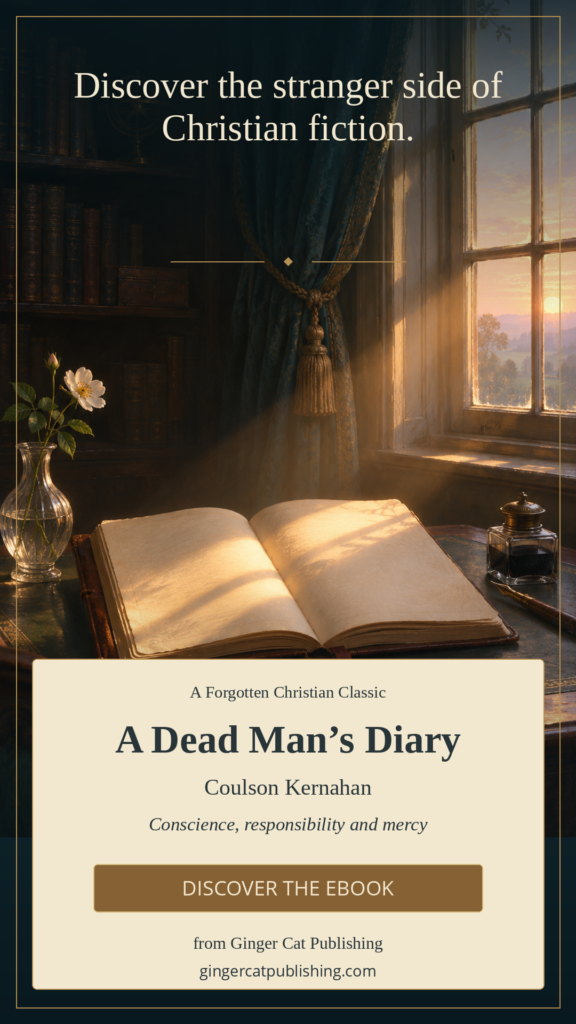
Not every forgotten Christian story is gentle, and not every worthwhile question arrives in comfortable surroundings. A Dead Man’s Diary brings something distinctly unsettling to the Weird & Wonderful strand of my imprint. Its strange setting gives us a man who has run out of reassuring descriptions of himself. What remains is the truth about his choices and the question of where he can turn with it.
That is the reason I wanted to make room for the book. Its theology requires care, but its concern with self-deception is not difficult to recognise. There are passages to question, others to sit with, and an author who is unlikely to let every reader remain entirely comfortable. If that sounds like a reading conversation you would welcome, you can discover the eBook at Ginger Cat Publishing, with the supporting material there to help you think it through.
Sources Consulted
Coulson Kernahan, A Dead Man’s Diary, 1890, including G. T. Bettany’s original preface. Source for the narrative, original presentation, literary references and publication background. https://www.gutenberg.org/cache/epub/72971/pg72971.txt
Coulson Kernahan, In Good Company, 1917. Source for the author’s own retrospective account of his literary acquaintances. https://www.gutenberg.org/files/51572/51572-h/51572-h.htm
The Encyclopedia of Science Fiction, Kernahan, Coulson. Source for biographical dates, places and the range of his published fiction. https://sf-encyclopedia.com/entry/kernahan_coulson