
This article contains affiliate links to relevant editions on Amazon. As an Amazon Associate, Ginger Cat Publishing earns from qualifying purchases.
At the top of a large, silent house lives a small boy whom the adults below scarcely seem to know. His name is Robert Stuart Allonby, though his nurse calls him Master Bobby and his relations refer to him simply as ‘the Child’. He has rooms, meals, clothes and supervision. What he lacks is the feeling that his presence matters.
This is the quiet ache at the heart of Me and Nobbles, Amy Le Feuvre’s 1908 story of childhood faith and longing. Bobby is not entirely alone. He has Nobbles, a walking stick with a curious ivory head, round eyes, large ears and a little red cap. To everyone else Nobbles is an object. To Bobby he is confidant, fellow traveller, protector and friend.
The premise might sound whimsical, but Le Feuvre does not use it merely to make Bobby quaint. Nobbles reveals how an imaginative child survives emotional neglect. The stick cannot interrupt, dismiss or misunderstand him. Nobbles is always available for Bobby’s questions, and Bobby has questions about almost everything: fathers, death, heaven, sin, love, belonging and the mysterious reasons grown-ups behave as they do.
The result is a story with the outward shape of a children’s adventure and the inward seriousness of a book about being seen. Its Christian faith is direct, but its deepest movement begins even before Bobby can put theology into words. He wants to know that he belongs to someone, that he is loved while absent from the beloved, and that there is a home whose door will not be closed against him.
The child at the top of the house
Le Feuvre opens not with Bobby, but with the house that contains him. The front windows stare down upon the drive. The dining room is austere, the drawing room unused, and the library gloomy. Everything is ordered, respectable and emotionally cold. A visitor notices tiny signs of another life: a child’s glove, a toy watering can, a bunch of daisies crushed by a warm hand, the distant sound of laughter. She asks whether the house is haunted.
The answer is more painful than a ghost story. Yes, there is a child, but he is kept in the nurseries at the top of the house so that the family need not be ‘continually reminded of his presence’. His mother is dead. His father is abroad and has allowed years to pass without returning. His grandmother provides for him but does not welcome him into the life of the household.
In a prosperous late Victorian or Edwardian home, the physical separation of children and adults would not itself have seemed unusual. Nurseries were often set apart from adult rooms, and much daily care could be entrusted to a nurse or nanny. The presence of a green baize door in the story is especially telling. Such doors marked the boundary between the family’s public world and the working spaces through which servants moved. Bobby lives beyond that boundary, socially related to the family but managed almost as part of the domestic machinery.
Le Feuvre is careful, however, not to reduce the problem to architecture. A nursery can be loving, and Bobby’s nurse does care for him beneath her severity. The injury lies in the adults’ conviction that good management is enough. His grandmother visits each morning to inspect his health and comfort, but no one asks what fills his mind. He is protected without being known.
That distinction gives the book much of its lasting force. A child may have every visible necessity and still be lonely. Bobby does not possess modern psychological language for neglect, so Le Feuvre lets us hear it through his habits. His favourite opening is ‘I wonder, Nurse’, but the impatient expression on her face often stops him before the question is complete. He turns instead to Nobbles.
The story never mocks him for doing so. His friendship with the stick is funny, tender and entirely coherent. Children often animate cherished objects through imaginative play, but Bobby’s attachment carries an added weight. Nobbles is a safe listener in a world where adult attention is scarce. When the stick is broken, Bobby’s grief is not foolishness over damaged wood. Something that has held his secrets and steadied his inner life appears to have been killed.
Seven years old, and reasoning towards love
The novel does not explicitly state Bobby’s age. It describes him as a very small boy who is beginning to read, remains under nursery care and may soon be sent to school. His speech, play and growing ability to follow an idea through its consequences make seven a reasonable imaginative estimate, though it should remain an inference rather than a fact supplied by the text.
What matters more than the number is Le Feuvre’s grasp of a child poised between magical thinking and moral reasoning. Bobby accepts that Nobbles can think and act, yet he is also capable of sustained argument. He takes adult statements seriously, compares them, notices contradictions and follows them into places the speaker did not intend.
When his nurse tells him that God is ‘Our Father’, Bobby first objects because God is not his own absent father. She explains that fathers love, work for and care for their children, and that God is called Father because He loves him. Bobby draws a conclusion of enormous emotional importance: he has two fathers, both far away, both loving him.
It is innocent reasoning, but not shallow reasoning. Bobby builds his idea of divine fatherhood from his hunger for an earthly father, while his hope in God helps him continue trusting that his earthly father has not forgotten him. Each relationship illuminates the other. The book’s title may sound cheerfully ungrammatical, yet the story is preoccupied with relationship: Bobby and Nobbles, Bobby and his father, the child and God.
Le Feuvre preserves Bobby’s pronunciation and grammar throughout. He says ‘picsher’, ‘acause’, ‘fink’ and ‘everybodies’; he produces double negatives and child-shaped tenses. These are not random errors in the text. They are part of the author’s attempt to place us close to his spoken voice. Modern readers may need a few pages to find the rhythm, but the effect is intimate. Bobby does not deliver polished adult doctrine in miniature. He reaches for meaning with the vocabulary he has.
There is humour in this, particularly when his literal answers expose adult evasions. Yet the humour rarely turns cruel. More often, the adults discover that the child has understood the moral centre of a situation more clearly than they have. He may misunderstand a convention or a figure of speech, but he recognises loneliness with startling speed because he knows it from within.
A Bible made visible
One of the most memorable objects in Me and Nobbles is an old Italian Bible in the gloomy library. It is bound in soft brown leather, ornamented with brass and turquoise, and filled with pictures. Bobby cannot properly read it, but he can enter it through touch, colour and image. He handles the clasps, presses his cheek to the leather and turns the painted pages with reverence.
His attention settles on a vision near the end: golden gates, white-robed figures, a river, a tree heavy with fruit and a shining city beyond. Outside the gates, miserable people plead to be admitted. The imagery gathers elements from the final chapters of Revelation, including the holy city, the river of life, the tree of life and entry through the gates.
This scene belongs to a world in which biblical knowledge reached children through several senses at once. A child might encounter Scripture in family prayers, church services, Sunday school lessons, hymns, illustrated Bibles, reward books and the repeated phrases of the Authorised Version. The Religious Tract Society, which published the novel in London in 1908, had grown from its evangelical beginnings into a major producer of books and periodicals, including a substantial body of reading for children. Le Feuvre’s story sits naturally within that culture, but it also shows how unpredictable a child’s reception of religious material can be.
The adults see a valuable book, a sermon topic or a familiar doctrine. Bobby sees people shut outside a beautiful home, and the sight frightens him. His first concern is practical and urgent: how can he and Nobbles obtain the white robes needed to enter? His nurse’s brisk answer, that only good little boys go to heaven, increases rather than resolves his fear.
Here Le Feuvre touches a difficult truth about religious education. Words offered carelessly to a child can carry more terror than an adult realises. Bobby’s imagination is vivid enough to make the golden city real, but also vivid enough to make exclusion real. He needs someone who will listen closely to the question beneath his question.
That listener is Lady Isobel, a bereaved woman whom Bobby befriends. Their companionship is beautifully balanced. She possesses the language to explain the Christian message more fully, but Bobby possesses the trust and openness that her grief has endangered. Neither simply instructs the other. Each gives the other a way back into hope.
Lady Isobel explains the white robe not as something bought or earned by flawless behaviour, but through the book’s evangelical understanding of Christ’s saving work. The distinction matters. Bobby has been measuring himself against the impossible demand to be ‘good enough’. Grace changes the image from a locked gate guarded by achievement into an offered belonging received by faith.
The wording that becomes precious to him reflects Revelation 22:14 in a textual form that speaks of washing robes in the blood of the Lamb. Some English Bible traditions instead read ‘do his commandments’. The novel itself notices this difference and makes it part of a later conversation. Le Feuvre is not using the verse as decoration. She places two emphases beside one another, obedience in life and reliance upon Christ at death, then allows a dying character to express why the language of grace brings her comfort.
The hymn above the bright blue sky
Bobby’s vision of heaven is also shaped by a children’s hymn heard in church: ‘There’s a Friend for little children / Above the bright blue sky’. Written by Albert Midlane in 1859, the hymn became widely used and appeared in hundreds of hymnals. Its verses name a friend, rest, home, crown, song, robe and other treasures ‘above the bright blue sky’.
Le Feuvre draws these images into Bobby’s consciousness with great economy. To an adult congregation, the list might be familiar devotional language. To Bobby, each item becomes concrete. If there is a robe, where does one get it? If there are gates, who may pass through? If heaven is home, will the people he loves be there?
The hymn also sharpens the book’s central contrast. Bobby has a well-appointed earthly residence but not, at first, a felt home. Heaven attracts him not simply because it glitters, but because everyone within it belongs. The city is full of welcome, music, fruit, companionship and light. It is the opposite of the silent old house, where rooms are maintained but affection is withheld.
For readers in 1908, the language of heaven would have had an additional immediacy. Childhood mortality had fallen considerably over the Victorian period but remained far higher than it is in Britain today, and families lived with death more closely. Mourning customs, memorials, hymns and consolation literature formed part of ordinary culture. A children’s story could address death directly without assuming that the subject itself was unsuitable.
That does not mean every religious treatment was gentle, and modern readers may find the novel’s images of blood, judgement and exclusion intense. Le Feuvre does not avoid them. What she does, at her best, is follow a sensitive child through fear towards assurance. The spiritual argument is inseparable from the emotional one: Bobby needs to know that love is not merely declared from far away, but makes a way for him to come home.
The absent father and the age of travel
Bobby’s father belongs partly to the adventure world of the late nineteenth and early twentieth centuries. He has travelled abroad, and Bobby imagines him among distant peoples, mountains and dangers. Motors, trains and tales from a sailor widen the horizon beyond the walled garden. The British Empire is not examined critically in the novel, but its geography sits in the background as a familiar imaginative map of ‘foreign parts’, exploration and masculine adventure.
This helps explain Bobby’s fantasy of reunion. His father will not simply walk up the drive like an ordinary visitor. He will arrive from the great unknown and carry Bobby into a life of movement, courage and companionship. The longing is partly filial and partly adventurous because, for Bobby, the two have grown together. To be claimed by his father is to be admitted into the larger world.
When the father finally appears, Le Feuvre wisely refuses to make him the magnificent figure of Bobby’s dreams. Mr Allonby is affectionate but unsettled, impulsive, financially uncertain and accustomed to freedom. Bobby discovers that being loved and being responsibly cared for are not identical. A father may feel love and still need to learn how to live it.
That is one of the book’s more mature insights. The adults are not divided neatly into saints and villains. Bobby’s grandmother is cold, but she believes she has provided properly for him. His nurse is sharp, but devoted. His father has neglected him, yet is capable of repentance and tenderness. Lady Isobel is compassionate, yet burdened by sorrow. Bobby’s trust does not instantly solve them. It calls them into relationship, where change becomes possible.
The return of the father therefore answers only the first form of Bobby’s longing. The rest of the novel asks what happens after reunion. Can a restless man become a present father? Can a child share the beloved person he has imagined as his alone? Can grief create a new family rather than merely empty an old one?
Le Feuvre gives Bobby a household very different from the one at the beginning. It is smaller, less formal and far less secure in material terms. There is another child, True, and a motherly presence whose illness brings sorrow into their new happiness. Yet Bobby is no longer hidden at the top of the house. He is involved in the needs, decisions and affections of family life.
When a child’s faith meets adult grief
The novel’s most affecting passages occur when Bobby’s bright vision of the golden city meets bereavement. Because he believes heaven to be real, he initially responds to approaching death with eagerness that an anguished adult mistakes for heartlessness. Le Feuvre pauses to correct the misunderstanding. Bobby is not pleased by loss. He simply sees the promised life beyond it so vividly that, for a moment, its glory eclipses the shadow before him.
This is characteristic of the whole story. Adults repeatedly judge the outer form of a child’s words without entering the thought behind them. Bobby’s phrasing can sound comic, blunt or even inappropriate, but his intention is usually loving. His errors of manner coexist with a remarkable seriousness of heart.
The dying Mrs Allonby understands him. She speaks to Bobby and True honestly, without pretending that separation is easy. She asks True to help create a home for her father and asks Bobby to become his companion. Her requests turn grief towards vocation, not in the grand public sense, but through ordinary acts of presence. A comfortable meal, conversation, shared work and faithful affection become ways of keeping a family from falling apart.
Bobby’s father, meanwhile, is changed not by a lecture but by need. In grief he prays beside his son’s bed, admits the selfishness of his life and asks to become different. The scene reverses the expected direction of religious teaching. The adult’s prayer becomes one of the child’s lasting memories, while the child’s vision gives the adult words and images with which to face loss.
This reciprocity saves the novel from being merely a tract in fictional dress. Its doctrine is openly evangelical, yet its people matter as people. Faith travels through friendship, misunderstanding, repair and shared sorrow. Bobby does not persuade because he is precociously eloquent. He persuades because the adults sense that his trust is bound up with love.
Amy Le Feuvre and the misunderstood child
Amy Le Feuvre, whose full name was Amelia Sophia Le Feuvre, lived from 1861 to 1929. She began publishing books in the 1890s and produced a substantial body of fiction for children and adults. The title page of the 1908 edition presents her as the established author of several earlier stories, including Probable Sons, Teddy’s Button, Jill’s Red Bag, Odd and His Little Daughter. The Religious Tract Society was one of the publishers through which her distinctive combination of story, childhood experience and evangelical faith reached readers.
The bare outline is useful, but the clearest evidence of her particular gift remains in the stories themselves. Again and again, Le Feuvre was drawn to children whose motives are mistaken by grown-ups. They may be impulsive, literal, dreamy or outwardly naughty, but their inner lives possess an integrity the surrounding adults have overlooked.
Bobby is a particularly fine example because his goodness is not tidiness. He runs away, trespasses, makes reckless plans, quarrels, resents sharing his father and risks danger. He also loves with his whole being. Le Feuvre allows these traits to belong to the same child. His trust is not the absence of temperament. It works through his temperament.
That may be one reason the story can feel unexpectedly close to home. Readers who remember being the child whose questions were brushed aside may recognise Bobby’s retreat into an imaginative companionship. Parents and grandparents may recognise the uncomfortable moment when an inconvenient question reveals that a child has been listening far more carefully than anyone supposed. Those who have waited for an absent person may recognise Bobby’s stubborn refusal to believe that distance means indifference.
The novel also invites a gentle caution. Bobby’s unquestioning confidence in his father is beautiful, but the adult reader sees the cost of the father’s absence. Love imagined by a child cannot relieve the adult of responsibility. Mr Allonby’s return matters because affection must eventually become presence, protection and daily faithfulness.
From the silent house to a place of belonging
By the closing pages of Me and Nobbles, the old house has changed. It is no longer simply the place where Bobby waited unseen. New relationships have entered it, old griefs have softened, and the rooms that once seemed to repel life begin to hold family life again. The transformation is not architectural. It comes because people have learned to notice, receive and need one another.
Bobby’s earthly story and his vision of the heavenly city have been moving towards the same word all along: home. At first, home is what he lacks despite having an address. Later, it is what he discovers through being claimed and through learning that belonging includes responsibility for others. Finally, it is the larger Christian hope represented by the city and its open gates.
Nobbles remains with him. The stick is repaired after being broken and continues to accompany Bobby through danger, reunion and change. That continuity matters. Growing into new relationships does not require Bobby to despise the imaginative companion who sustained him in loneliness. Nobbles is ‘a kind of part of me’, he explains. The adults who have learned to love Bobby can make room for that part too.
Perhaps this is why the book’s title feels exactly right. Corrected into formal grammar, it would lose something essential. Me and Nobbles is Bobby’s own ordering of the world, affectionate, immediate and unashamed. Before the grown-ups properly see him, there is Bobby and his faithful companion. When his father comes, Bobby’s instinct is not to discard the stick but to enlarge the circle.
More than a century after its first publication, the story asks questions that have not become old. What does a child hear when adults speak casually about love, God or death? What is the difference between providing for someone and knowing them? Can simple trust survive disappointment without becoming mere illusion? What turns a house into a home?
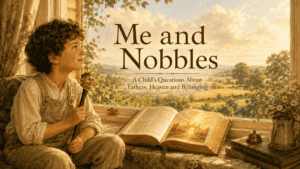
Le Feuvre does not answer through abstraction. She gives us a small boy at a high nursery window, looking across walls and fields towards a road from which someone may come. Beside him is a ridiculous, beloved walking stick. Above him is the bright blue sky. Before him, in imagination and faith, stand golden gates and a city where belonging is complete.
Sources Consulted
The complete 1908 text of Me and Nobbles, used as the primary authority for plot, character, setting and quotations.
Hymnary: “There’s a Friend for Little Children”
Lutterworth Press: history of the Religious Tract Society and its children’s publishing
Manchester Metropolitan University: Country House Servants research exhibition
The Children’s Country House at Sudbury, National Trust Collections
Office for National Statistics: long-term mortality trends in England and Wales