

More than a century after its publication, A Study in Scarlet continues to attract new readers, spark debate, and inspire endless adaptations. It introduced Sherlock Holmes and Dr. Watson to the world in 1887, helped define modern detective fiction, and remains one of the most discussed mystery novels ever written.
Yet what is most interesting is not simply that people still read the book. It is the kinds of questions they ask once they finish it.
Readers today often arrive expecting a straightforward Victorian detective mystery. Instead, they encounter something stranger, more ambitious, and occasionally more challenging than anticipated. The novel moves between foggy London streets and the American frontier. It blends murder investigation with revenge tragedy. It introduces one of fiction’s most famous detectives while also questioning whether legal justice and moral justice are always the same thing.
These are the questions modern readers most often ask about A Study in Scarlet, and why the answers continue to matter.
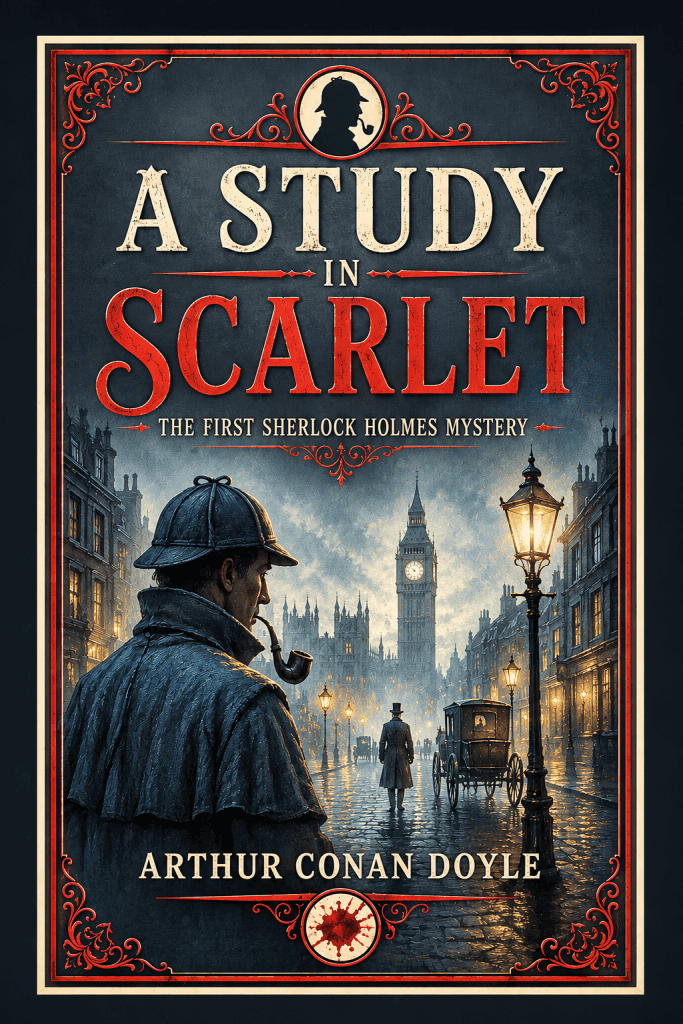
This article contains affiliate links to relevant editions on Amazon. As an Amazon Associate, Ginger Cat Publishing may earn from qualifying purchases.
Why Does the Book Suddenly Leave London?
This is probably the single most common reaction modern readers have.
One moment the story is unfolding as a classic murder investigation in Victorian London. The next, the novel abruptly shifts to Utah Territory and begins telling an entirely different story.
To contemporary readers, the transition can feel startling. Some even wonder if they have accidentally skipped into another book.
Victorian audiences, however, were far more accustomed to sprawling narrative structures. Nineteenth century fiction regularly combined genres, locations, and storytelling styles within a single work. Adventure fiction, sensation novels, romances, and mysteries often moved across continents and decades without apology.
Conan Doyle was writing for readers who enjoyed dramatic backstories and hidden histories. The murder in London was never meant to stand alone. The crime only makes emotional sense once readers understand the long trail of suffering, loss, and revenge behind it.
In many ways, A Study in Scarlet is not simply a detective story. It is a novel about the consequences of the past catching up with the present.
Is Sherlock Holmes Really Using “Deduction”?
Readers often describe Holmes’s methods as deduction, but modern scholars and detectives frequently point out that Holmes actually relies more heavily on observation and inference.
He notices details others dismiss as unimportant, then connects them into larger patterns.
A watch chain, a stain, a boot print, a gesture, or the condition of someone’s hands becomes evidence. Holmes’s genius lies not in magical intuition, but in disciplined attention.
This felt revolutionary in the late Victorian period.
Scientific thinking was reshaping medicine, chemistry, and criminal investigation. Conan Doyle drew heavily from the growing belief that logic and observation could uncover hidden truths. Holmes represented a modern kind of intelligence: analytical, rational, and methodical.
That influence still shapes detective fiction today. Nearly every fictional investigator who studies evidence, reconstructs crime scenes, or notices overlooked details owes something to Holmes.
Why Is Watson the Narrator Instead of Holmes?
This question reveals something important about why the Holmes stories work so well.
If Holmes narrated the stories himself, much of the mystery would disappear immediately. Readers would see the clues too early. More importantly, Holmes would risk becoming emotionally distant and difficult to relate to.
Watson changes everything.
He allows readers to experience Holmes from the outside. We share Watson’s amazement, confusion, admiration, and occasional frustration. Watson acts as a bridge between Holmes and the audience.
He also brings warmth and humanity to the stories.
Modern readers sometimes underestimate how emotionally important Watson is to the Holmes canon. Holmes may provide the intellectual brilliance, but Watson provides the emotional grounding. Their friendship gives the stories heart.
That partnership became one of the most influential character dynamics in literature.
Why Does Holmes Feel More Human Here Than in Later Stories?
Many readers notice that Holmes in A Study in Scarlet feels younger, less polished, and slightly more emotionally accessible than the Holmes of later stories.
Partly this is because Conan Doyle himself was still discovering the character.
Holmes had not yet become a cultural icon. He was still evolving on the page. In this first novel, readers see flashes of humour, vanity, excitement, and uncertainty that later adaptations sometimes smooth away.
Watson is also meeting Holmes for the first time, which gives the character a sense of mystery and unpredictability. The famous detective has not yet become fully mythologised.
There is something intimate about watching the Holmes and Watson partnership begin before either man fully understands how important it will become.
Is Jefferson Hope Supposed to Be Sympathetic?
One reason A Study in Scarlet still feels surprisingly modern is its moral complexity.
The novel does not present its murderer as purely evil. Jefferson Hope is driven by grief, injustice, and long-sustained suffering. Readers are encouraged to understand him emotionally even while recognising the violence of his actions.
This raises uncomfortable but fascinating questions.
Does personal suffering excuse revenge?
Can legal systems fail so badly that private vengeance begins to seem understandable?
Should readers judge Hope differently because of what he endured?
Victorian crime fiction often focused on restoring order through punishment. Conan Doyle complicates that pattern. Holmes solves the crime, but solving it does not necessarily resolve the moral questions beneath it.
That ambiguity remains one of the novel’s enduring strengths.
Is the Mormon Section Historically Accurate?
This is one of the most sensitive and frequently discussed aspects of the novel today.
The short answer is no. Conan Doyle’s portrayal of Mormon communities in Utah is heavily fictionalised and shaped by Victorian sensationalism rather than careful historical accuracy.
British readers in the nineteenth century often encountered Mormonism through alarming newspaper reports, rumours, and adventure fiction. The American West itself was widely imagined as exotic, dangerous, and lawless.
Conan Doyle drew upon those existing cultural anxieties.
Modern readers understandably approach these sections more critically. Some adaptations remove them almost entirely, while annotated editions often provide historical context explaining the gap between fiction and reality.
Reading older literature responsibly does not require ignoring problematic material. Instead, it means understanding how historical assumptions shaped the work while still engaging with its literary importance.
This is one reason contextual editions remain valuable. They help readers approach classic works thoughtfully rather than uncritically.
Why Is A Study in Scarlet So Important to Detective Fiction?
The novel helped establish many conventions that still define detective stories today.
The eccentric genius detective.
The loyal narrator companion.
The baffling crime scene.
The methodical investigation.
The dramatic reveal.
The belief that careful reasoning can uncover hidden truth.
These elements now feel familiar partly because A Study in Scarlet helped popularise them.
Earlier fictional detectives existed before Holmes, including Edgar Allan Poe’s C. Auguste Dupin, but Holmes transformed the genre into something broader and more enduring. Conan Doyle created a detective who felt modern, scientific, and endlessly adaptable.
The influence extends far beyond literature.
Modern crime dramas, police procedurals, forensic thrillers, and investigative television all carry traces of Holmes’s methods and structure.
Why Does the Book Still Matter Today?
Perhaps because its deeper concerns still feel familiar.
People remain fascinated by hidden lives, concealed motives, and the idea that ordinary appearances may hide extraordinary truths. Cities still create anonymity. Institutions still fail. Questions about justice remain complicated.
And Holmes himself continues to appeal because he represents a reassuring idea: that careful observation and rational thought can still bring clarity to a confusing world.
Yet the emotional core of the novel matters just as much.
At the centre of A Study in Scarlet is not only a murder mystery, but also the beginning of a friendship. Holmes and Watson endure because they balance one another so perfectly. Intelligence and compassion. Logic and humanity. Isolation and companionship.
That partnership still feels alive more than 130 years later.
Which may be the greatest mystery of all.
At Ginger Cat Publishing, we believe classic novels become richer when readers are given the historical context, literary background, and thoughtful commentary needed to fully appreciate them. Our editions are designed not only to preserve timeless stories, but to help modern readers engage with them in meaningful ways.
View the Ginger Cat Publishing Edition on Amazon