
For a novel published in 1885, Adventures of Huckleberry Finn asks some surprisingly modern questions.
How do you know when society is wrong?
What happens when the people around you expect one thing, but your conscience tells you another?
How do friendships change us?
And what does freedom really mean?
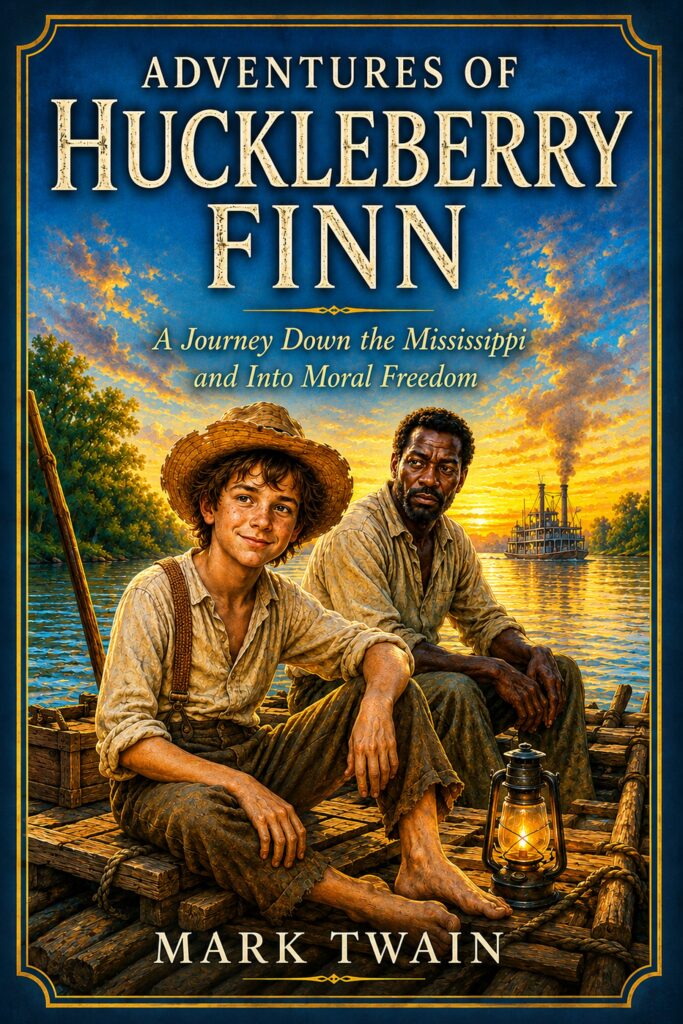
These questions sit at the heart of Mark Twain’s famous novel, which follows a boy named Huck Finn as he travels down the Mississippi River with an escaped enslaved man named Jim. On the surface, it may sound like a simple adventure story. There are riverboats, feuding families, conmen, narrow escapes, and moments of humour that still raise a smile.
Yet beneath the adventure lies something far more interesting. Huckleberry Finn is a story about learning to think for yourself.
That is one reason readers continue to find value in it well over a century after it was first published.
This article contains affiliate links to relevant editions on Amazon. As an Amazon Associate, Ginger Cat Publishing may earn from qualifying purchases.
More Than a River Adventure
Many people approach Huckleberry Finn expecting a children’s book. After all, Huck is a boy, and the novel is often taught in schools.
What they often discover instead is a surprisingly thoughtful exploration of morality, friendship, and human dignity.
Huck is not a polished hero. He is poorly educated, often confused, and shaped by the prejudices of the society around him. He does not set out on his journey intending to challenge injustice or become a better person. In many ways, he simply wants to escape people telling him what to do.
That makes him feel remarkably human.
Unlike many literary heroes, Huck learns gradually. He makes mistakes. He misunderstands things. He struggles to know what is right. Readers are not watching a perfect character teach lessons from a position of wisdom. They are watching an ordinary person wrestle with difficult questions as they arise.
There is something reassuring about that.
Most of us do not arrive at our beliefs fully formed. We learn through experience, through relationships, and sometimes through discovering that things we once accepted without question may not be as simple as they seemed.
A Story About Conscience
Perhaps the most powerful aspect of Huckleberry Finn is its focus on conscience.
Throughout the novel, Huck finds himself caught between what he has been taught and what he begins to feel is right.
The society around him tells him that Jim is property. The law tells him that helping Jim escape is wrong. Many of the adults Huck encounters reinforce these beliefs without hesitation.
Yet Huck’s personal experience tells a different story.
As he spends time with Jim, he comes to know him not as an abstract idea but as a person. He sees his kindness, loyalty, fears, hopes, and humanity.
The conflict that follows is what gives the novel much of its emotional weight.
Readers do not need to share Huck’s circumstances to recognise this struggle. Most people have experienced moments when social expectations, group opinion, or accepted wisdom clash with what they believe deep down.
Those moments are rarely comfortable.
Twain understood that moral courage often begins not with certainty, but with confusion. Sometimes doing the right thing means questioning assumptions that everybody else seems perfectly happy to accept.
That idea remains as relevant now as it was in the nineteenth century.
Friendship at the Centre of the Story
Although the novel is often discussed in terms of its social and political themes, the relationship between Huck and Jim is what gives it its emotional heart.
Their friendship develops slowly and naturally. It is built through shared experiences rather than dramatic speeches.
They spend long stretches of time together on the river, talking, travelling, solving problems, and learning to trust one another. In many ways, the river becomes a space removed from the expectations of the world around them.
It is there that Huck begins to see Jim as a friend rather than through the categories society has imposed.
Readers often connect with this aspect of the novel because it reflects something familiar. Genuine friendships have a way of cutting through assumptions. They remind us that people are always more complex than labels, stereotypes, or first impressions suggest.
The friendship between Huck and Jim is not perfect, but it feels believable. That authenticity helps explain why it continues to move readers long after the details of the plot have faded from memory.
The Question of Freedom
Freedom means different things to different characters in the novel.
For Huck, freedom initially means escape. He wants freedom from rules, expectations, and the adults who attempt to control him.
For Jim, freedom carries a far greater significance. His freedom concerns safety, dignity, family, and the ability to shape his own future.
As the story unfolds, these different understandings of freedom begin to overlap.
Twain encourages readers to think about what freedom truly involves. Is it simply the absence of restrictions? Or does real freedom require responsibility, compassion, and concern for others?
These are questions that continue to appear in modern discussions about politics, society, relationships, and personal identity.
The novel does not offer simple answers. Instead, it invites readers to think alongside its characters.
That invitation remains one of its greatest strengths.
The Challenge of Reading It Today
Any honest discussion of Huckleberry Finn must acknowledge that some aspects of the novel can be difficult for modern readers.
The book contains racial language that many readers find uncomfortable and distressing. This language reflects the historical realities of the society Twain was depicting, but that does not make encountering it easy.
The novel’s use of regional dialect can also take time to adjust to. The spelling and speech patterns are intentionally different from standard written English.
For some readers, these elements become barriers.
For others, they become part of what makes the novel feel authentic.
Neither response is unreasonable.
What matters is understanding why these features exist and approaching the book with historical awareness rather than expecting it to conform to modern sensibilities.
Reading older literature sometimes requires patience. It asks us to step into a world shaped by different assumptions and values. While that can occasionally be uncomfortable, it can also deepen our understanding of both the past and the present.
Why Readers Still Return to It
There are many nineteenth-century novels that remain historically important but are rarely read outside academic settings.
Huckleberry Finn is different.
Readers continue returning to it because its central concerns remain recognisable.
People still wrestle with questions of conscience.
Friendships still shape who we become.
Societies still encourage conformity.
Individuals still struggle to distinguish between what they have been told and what they genuinely believe.
The details may change, but the underlying human experiences remain familiar.
Perhaps that is why the novel often feels more contemporary than its publication date suggests. Not because its world resembles ours, but because the people within it face questions that have never really gone away.
An Invitation to See Beyond the Reputation
Many people know Huckleberry Finn by reputation.
They know it is famous. They know it is often assigned in schools. They may even know that it has been the subject of debate and controversy.
What they may not realise is how thoughtful, funny, humane, and emotionally perceptive the novel can be.
It is not simply a book about a raft drifting down a river.
It is a book about friendship changing a person.
It is a book about learning to question assumptions.
It is a book about discovering that doing what is right is not always the same as doing what is expected.
And perhaps most importantly, it is a reminder that moral growth often begins when we start seeing other people as fully human.
That lesson feels no less important now than it did when Mark Twain first put pen to paper.
As readers, we often approach classic literature wondering whether a book from another century can still speak meaningfully into modern life. Sometimes the answer is no. Some books remain interesting primarily as historical artefacts.
Huckleberry Finn feels different.
Its river may belong to another age, but the questions flowing beneath the surface remain very much our own.
About the Ginger Cat Publishing Edition
At Ginger Cat Publishing, we believe classic literature is most rewarding when readers feel welcomed into it rather than intimidated by it.
Our edition of Adventures of Huckleberry Finn has been thoughtfully prepared with readability and reader experience in mind. Alongside the novel itself, we include carefully developed companion material designed to provide context, encourage reflection, and deepen appreciation of the story’s themes and historical setting.
For readers approaching Huck and Jim’s story for the first time, or returning to it after many years, our aim is to create an edition that feels both accessible and rewarding.
If you would like to spend some time on the Mississippi River in the company of one of literature’s most memorable narrators, we warmly invite you to explore the Ginger Cat Publishing edition on Amazon.